There are lots of ways to bring this work into what you already do, and I offer trainings for wherever you’re starting from. Explore all trainings for practitioners here.
✦ ◯ ✦
Article
Menstrual Cycle Education Training for Coaches, Teachers & Facilitators
If you’re a coach, yoga teacher, nutritionist or facilitator working with women, there’s a good chance your training left out the menstrual cycle completely, and you probably didn’t even notice or wonder if the framework you learned would need to change for a man or a woman. This is why I believe cycle-aware training belongs in every women’s practitioner’s toolkit.
I’m sharing this because I lived it myself. I was a yogi for ten years, and I really believed I understood my body. It took me a long time to discover my menstrual cycle and how it impacted me and my practice. And then how I was teaching women in my classes. Learning about my womb and cyclical nature changed my whole world, and I knew this was a huge gap in our wellness world.
Why menstrual cycle education was left out of most trainings
Women weren’t legally required to be included in clinical research until 1993, and that law only covered medical studies. For decades before that, (and since) research was done mostly on men, and everyone assumed the results would apply to women too.
The reason was our variability. A man’s hormones follow a 24-hour rhythm, rising in the morning and falling by night, a bit like the sun. Ours follow a cycle of roughly 28 days, more like the moon moving from dark to full and back again. Conducting studies with this cyclical variability takes much more time, more time costs more money, and so women were simply left out.
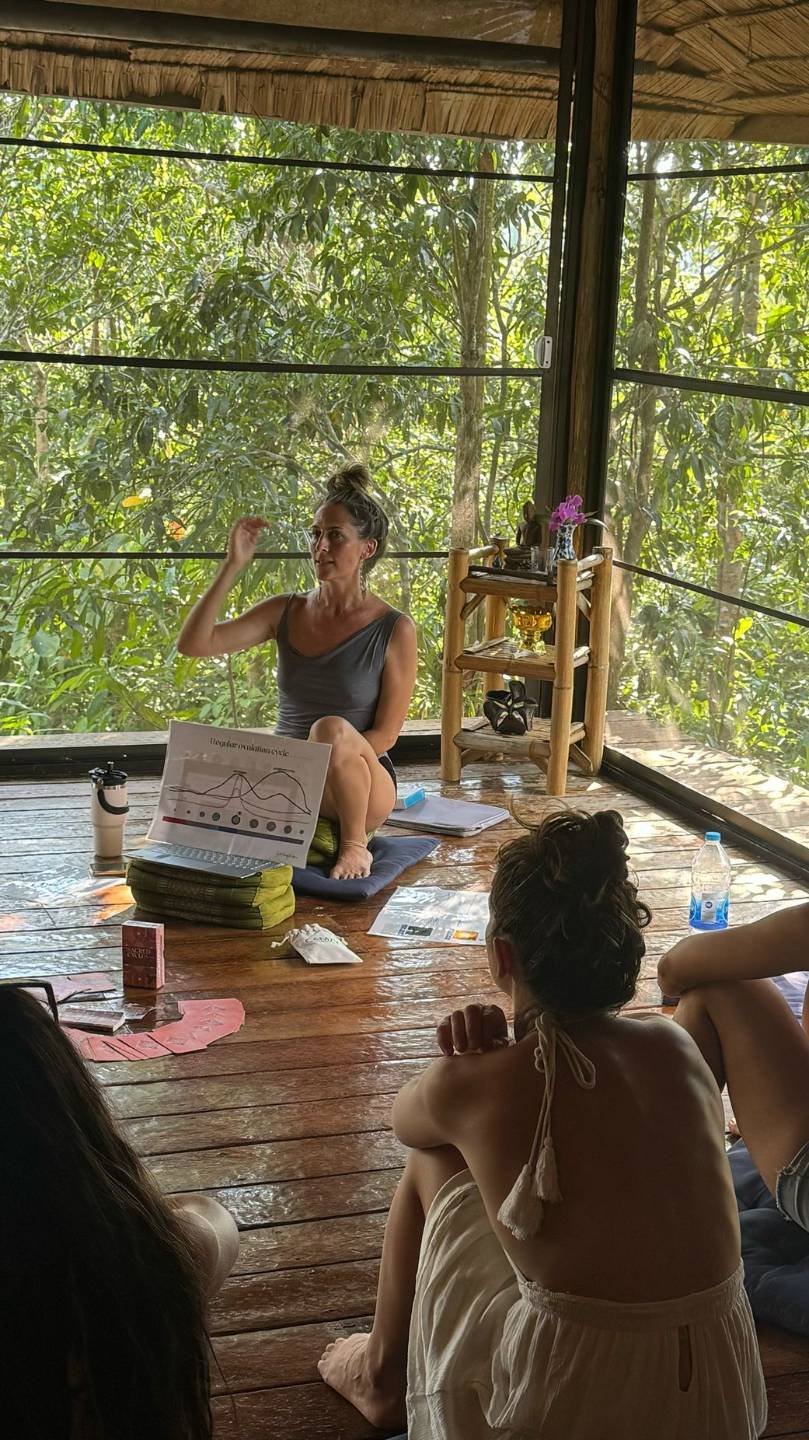
That gap didn’t stay in the lab, and this is the part I think matters most for you as a leader.
Most yoga trainings skip how to alter the asana or pranayam practice for a cyclical being. Coaching models tend to expect the same consistency and output every day. Popular nutrition approaches like keto, paleo and intermittent fasting were largely studied on male metabolisms and then handed to women as universal advice. Personal training plans are usually the same three sessions a week at the same time all month long, even though a woman’s stress resilience, recovery and physical capacity change across her cycle. Even the nine-to-five workday is built around a 24-hour rhythm.
So if you’ve ever watched a client lose confidence because she couldn’t show up the same way every day, and wondered whether she just needed more discipline, I’d love for you to consider that the framework you were both working inside was missing something important.
What happens when the menstrual cycle is left out of your work
When women learn, directly or indirectly, that their bodies should be the same everyday, we see a lot of exhaustion and overwhelm, and a dysregulated nervous system that women shame themselves for instead of understanding it as biology. There’s often a constant self-criticism underneath that most facilitators don't notice.
Underneath all of this, many women feel disconnected from their womb. I’ve had women in my sessions place a hand on their lower belly for the first time as adults, simply because nobody had ever invited them to. And waves of grief for not meeting this part of them sooner, with love and compassion roll through them.
Why women are looking for cycle-aware practitioners
Women are waking up to the reality that their body is different and they are starting to look for practitioners who understand how to work with their cyclical needs.
You can see the shift everywhere. Spain became the first country in Europe to approve paid menstrual leave, Vogue has covered cycle syncing, and the Flo period-tracking app has been downloaded over 380 million times. Women want support that understands their body. If a woman could choose between a personal trainer who trains everyone the same way and one who understands her cycle, I think we all know which one she’d pick.
Cycle-aware leader or menstrual cycle educator?
At Cyclical Living, we offer two different pathways to bring this into your work, and both are valuable.
A cycle-aware leader has a positive relationship with her own cycle and brings that awareness into how she runs her offerings. She might adjust her language or her protocols, or simply make room for the fact that the women in front of her are cyclical. That’s powerful on its own, and it sets you apart. It could look like a financial advisor who plans deep analytical sessions for a client’s follicular phase, a 24-hour cancellation policy with an exception for day one or two of a bleed, or twenty seconds at the start of a yoga class inviting women to notice where they are in their cycle.
Becoming a menstrual cycle educator goes further. If you want to support women with rewriting their relationship with being a woman, reclaiming her womb, her menstruation and deeper healing of PMS or period pain. If you want to teach the inner seasons, run circles or guide teens to start their cyclical journey differently, you need more than awareness. It’s a similar step to moving from trauma-aware to trauma-informed. Awareness on its own doesn’t create regulation, and the embodied side of this work takes skill, a real body of knowledge and structure to transmit this education and facilitate the change you want to see in the world.
Start with the 2hr Cycle-Aware Training
If you’re new to this, the 2hr Cycle-Aware Training is a great place to start. It’s a 2-hour training on the menstrual cycle and what it means to lead as a cycle-aware woman, and you can watch it straight away at your own pace.
Over 2,500 women have come through it this year, many of them coaches, yoga teachers, doulas and therapists who wanted to understand the layer their training left out.
Explore all Cycle-Aware trainings for practitioners here.
Embodied Menstrual Cycle Educator training: going deeper
For practitioners who want to teach this work, I created the Embodied Menstrual Cycle Educator Certification. It’s a 100-hour, IPHM-accredited training that brings together the science, the somatics and the emotional and spiritual side of being a woman, because I believe you can only guide another woman as deep as you’ve gone yourself.
Inside, we cover:
✦ The menstrual cycle and inner seasons as a self discovery tool
◯ Nervous system & somatic embodiment practices
✦ Womb yoga & womb meditation
◯ Cyclical Living tools including nutrition & movement for each cycle phase
✦ A balanced module on birth control & fertility awareness, so you can support women’s informed choices without an agenda
◯ Facilitation & business foundations, so you know how to hold this work in groups, 1:1 & with teenagers just starting their cycles
Over 70 women have now certified as Menstrual Cycle Educators. Some are psychologists weaving it into their existing practice, some are yoga teachers bringing it into their studios, and others run corporate workshops, mother-daughter circles or online courses. There’s no one-way to take this work out to the world, and every one of them started where you might be now, noticing that something was missing and deciding to do something about it.
Cycle-aware training FAQs
What is cycle-aware training?
What’s the difference between cycle-aware training and menstrual cycle educator training?
How do I become a menstrual cycle educator?
Is the Menstrual Cycle Educator Certification accredited?
Can I do Menstrual Cycle Education training online?
Who are these trainings for?

Written by Jaime Lauren
Menstrual Cycle Educator & Somatic Practitioner
I am the founder of Cyclical Living, a trauma-informed school for Teachers, Coaches & Facilitators, and lead teacher of the Menstrual Cycle Educator Certification. I've trained over 70 women who are now carrying menstrual cycle education & female body wisdom into their own communities around the world.
My journey started as a yoga teacher who, after ten years of practice, felt like something was still missing. That missing piece was the connection to my womb, my cycle, and female body. For the last 7 years, I've been guiding women through personal transformation through the menstrual cycle, because I've found it to be the most powerful way to bring a woman back into her body and into deep trust with herself.
What sets my work apart is the bridging of evidence-based education and somatics. You'll understand the female nervous system with real depth, and you'll feel it in your own body, so this work becomes something you live, and something the women around you can feel.
✦ ◯ ✦